Binturong cryogenically frozen to ensure future survival of species
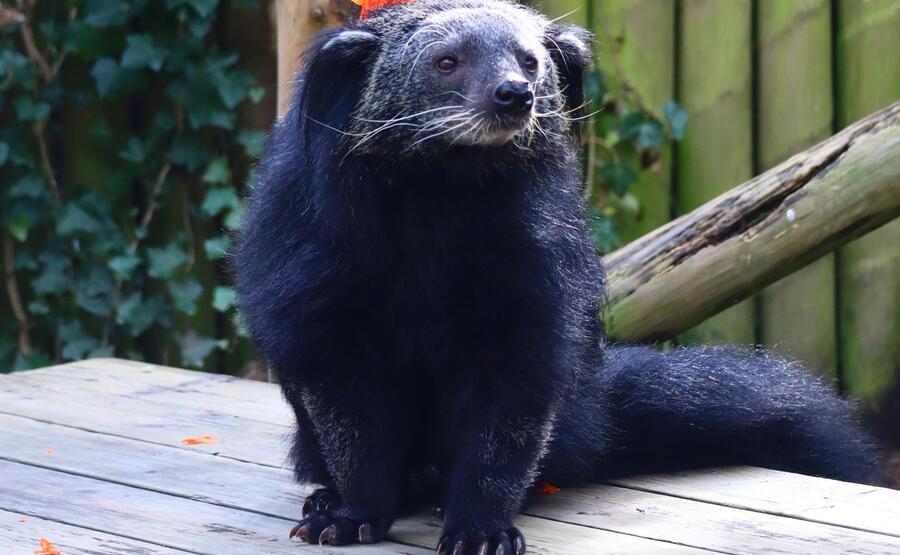
Posted: 12th August, 2024It is with heavy hearts that Drusillas Park in Sussex announced the passing of Penh, their beloved Cambodian binturong – one of just three of his subspecies in European zoos.
But they also announced that Penh’s legacy will live on - as his passing brings a new partnership with the charity Nature's SAFE. Thanks to the incredible work of Nature’s SAFE, Penh’s genetic footprint will be cryogenically preserved to aid the future survival of his subspecies.
Nature’s SAFE, one of the world’s first living biobanks, can be a lifeline for endangered species. As populations decline, the genetic diversity necessary for species survival is at risk. Nature’s SAFE addresses this critical issue by storing cells and tissues in a living state using advanced cryopreservation technologies. This includes the cryopreservation of sperm, reproductive, and skin cells which can be used to restore lost genetic diversity and bolster populations.
Keepers spoke about Penh as ‘a cherished member of our animal family since 2010’ and expressed their heartbreak at his loss, but joy knowing that he will contribute to such pioneering conservation initiatives. Penh lived to the grand old age of 18 and he was one of just three Cambodian binturongs (often nicknamed ‘bear cats’) in European Zoos. Penh was a true gentleman, a lover of tomatoes, and a sweet and gentle soul. He will be terribly missed by his keepers and Drusillas visitors who commented fondly on social media about his ‘buttery popcorn smell’.
The partnership between Nature’s SAFE and Drusillas embodies their shared commitment to conservation, and comes amid Drusillas founding and launching their own conservation charity – Drusillas Conservation in Action.
The object of Drusillas Conservtion in Action is to promote, for the benefit of the public, the conservation of wildlife across the world through the provision of grants to conservation charities and other organisations. Their vision is a world where wildlife thrives and nature is preserved.
Headkeeper Gemma, who was charged with delivering Penh’s cell tissue to Nature’s SAFE commented: “It felt very bittersweet, I’ve worked with Penh for over a decade so although I felt sad, it was also a positive feeling knowing it was not necessarily the end for him. The team at Nature’s SAFE lab immediately tested Penh’s sperm sample and we had confirmation that it was viable.”
The loss of Penh is of great sadness, but through this collaboration, his genetic legacy will live on, contributing to the conservation of binturongs for years to come.
Together, Nature’s SAFE and Drusillas are ensuring that future generations will continue to witness the wonderful diversity of the natural world.
Related Members
-
News
.png?w=100&h=100&zc=1&f=jpeg&hash=aad86ef4c29c1be4f7d49d7ddd0ae3d7) Blog: photo competition ignites my childhood wonder for the natural world 4th September, 2026BIAZA’s Andrew Hall reflects on the success of BIAZA’s 2026 Photography Competition and how it speaks to a lifetime of love for nature… …
Blog: photo competition ignites my childhood wonder for the natural world 4th September, 2026BIAZA’s Andrew Hall reflects on the success of BIAZA’s 2026 Photography Competition and how it speaks to a lifetime of love for nature… … -
News
.png?w=100&h=100&zc=1&f=jpeg&hash=b758c447d510c7c32d3c5afb8454dab2) All Things Wild Launches Six-Year Conservation Strategy and ‘More Than Just Your Local Zoo’ Campaign 1st September, 2026All Things Wild has today launched its first-ever six-year Conservation Strategy alongside a new park-wide campaign, ‘More Than Just Your Local…
All Things Wild Launches Six-Year Conservation Strategy and ‘More Than Just Your Local Zoo’ Campaign 1st September, 2026All Things Wild has today launched its first-ever six-year Conservation Strategy alongside a new park-wide campaign, ‘More Than Just Your Local… -
News
.png?w=100&h=100&zc=1&f=jpeg&hash=4466a39223e36e593a9c2b10c32baa71) Family-run Northumberland Zoo begins its next chapter as a registered charity 1st September, 2026After more than a decade of growth, Northumberland Zoo is taking its biggest step yet by becoming a registered charity, creating new opportunities to…
Family-run Northumberland Zoo begins its next chapter as a registered charity 1st September, 2026After more than a decade of growth, Northumberland Zoo is taking its biggest step yet by becoming a registered charity, creating new opportunities to…