
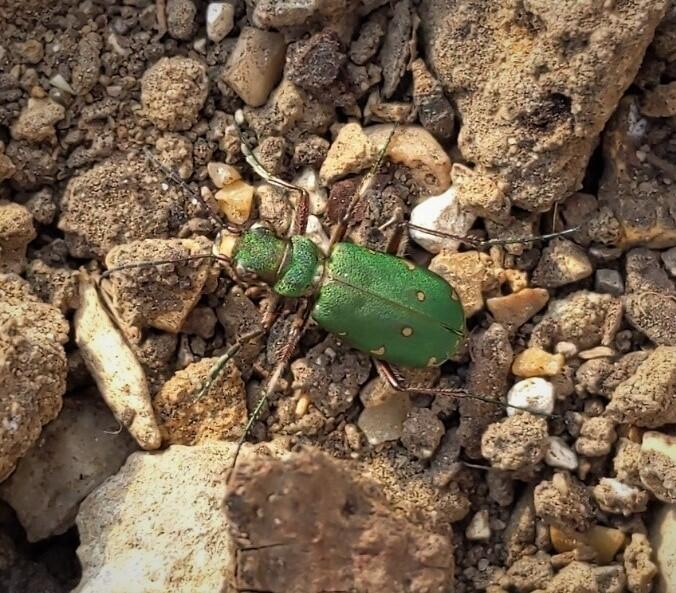

First Green Tiger Beetles Bred in Captivity Emerge as Adults
Posted: 31st March, 2022This week, twenty-two Green Tiger Beetles have emerged as adults, following the first successful captive breeding project for the species. This is part of a wider conservation project for rare beetles run by Sparsholt College and the Species Recovery Trust.
Green Tiger Beetles (Cicindela campestris), as the name suggests, are beautiful metallic green beetles. They are extremely fast runners and fearsome predators in the insect world. They are currently relatively widespread in the UK and can be found in a range of habitats, including lowland heathland and sandy grasslands. They are closely related to the Heath Tiger Beetle (Cicindela sylvatica), a species which is now sadly extremely rare in the UK and found in only a handful of places in the south of England.
To try to protect the rare Heath Tiger Beetle for the future, the Species Recovery Trust and Sparsholt College set up a captive breeding project. The ultimate aim is to reintroduce beetles to suitable sites in England, to increase both the number of sites in the country but also the number of beetles in some of the existing sites, where numbers appear to be critically low. To ensure that the team have a tried and tested protocol in place before capturing Heath Tiger Beetles from the wild, the project is focusing first on trying to breed Green Tiger Beetles. The beetles are so closely related that the lessons learnt from breeding Green Tiger Beetles can be used in the future to breed Heath Tiger Beetles successfully.
In spring of 2020, just as the first lockdown ended, a pair of Green Tiger Beetles were captured from the wild and moved to a dedicated enclosure at Sparsholt, designed to replicate their natural environment. Within a few weeks, fourteen larvae were spotted in small burrows in the sand. By September, the larvae had closed their burrows for the winter, to re-open the following spring for another season of intense feeding and growth. Finally, this week in a hugely exciting development, all fourteen have emerged into the sunshine as healthy adults.
This is a massive success and hopefully means that the project can now be expanded to include breeding Heath Tiger Beetles for reintroduction, which will hugely benefit the conservation of this incredibly rare species.
Emma Lawlor, zookeeper at Sparsholt College said “It has been a really exciting week seeing all our beetles emerge as adults, after rearing them for two years. The knowledge we have learned from captive rearing, such as ideal egg laying sites and soil choices, can now be used to help us raise the rare Heath Tiger Beetle. I feel the work done here at Sparsholt College will have a positive impact on native invertebrate conservation.”
Charlotte Carne, Programme Manager at the Species Recovery Trust, said: “For all twenty-two larvae to have emerged as adults is a fantastic result. We are really excited about expanding the project to include Heath Tiger Beetles, to help protect this incredibly rare species for the future.”
To find out more about the Species Recovery Trust, visit: www.speciesrecoverytrust.org.uk
Related Members
-
News
.png?w=100&h=100&zc=1&f=jpeg&hash=8e9c4f781070ade5a9e110a614e99e44) Blog: When Dublin Zoo celebrated a first-ever participation in Dublin Pride 17th July, 2026In June, Dublin Zoo donned Pride regalia and joined the celebrations for the first time. Dr Andrew Mooney (Conservation and Science Manager, Dublin Zoo)…
Blog: When Dublin Zoo celebrated a first-ever participation in Dublin Pride 17th July, 2026In June, Dublin Zoo donned Pride regalia and joined the celebrations for the first time. Dr Andrew Mooney (Conservation and Science Manager, Dublin Zoo)… -
News
.png?w=100&h=100&zc=1&f=jpeg&hash=95fa6b2703c57d7d96987f15128f9072) Bristol Zoo Project launches global search for Critically Endangered fish's perfect match 17th July, 2026Bristol Zoo Project has launched a global search to find a match for a Critically Endangered Cameroon cichlid after discovering that just one individual…
Bristol Zoo Project launches global search for Critically Endangered fish's perfect match 17th July, 2026Bristol Zoo Project has launched a global search to find a match for a Critically Endangered Cameroon cichlid after discovering that just one individual… -
News
.png?w=100&h=100&zc=1&f=jpeg&hash=4ce84f590bd19ee38ea88e893677ef33) Wild kittens born to released females for third year in a row 16th July, 2026Saving Wildcats has announced a third consecutive year of wild births, with several released females confirmed to have given birth…
Wild kittens born to released females for third year in a row 16th July, 2026Saving Wildcats has announced a third consecutive year of wild births, with several released females confirmed to have given birth…