
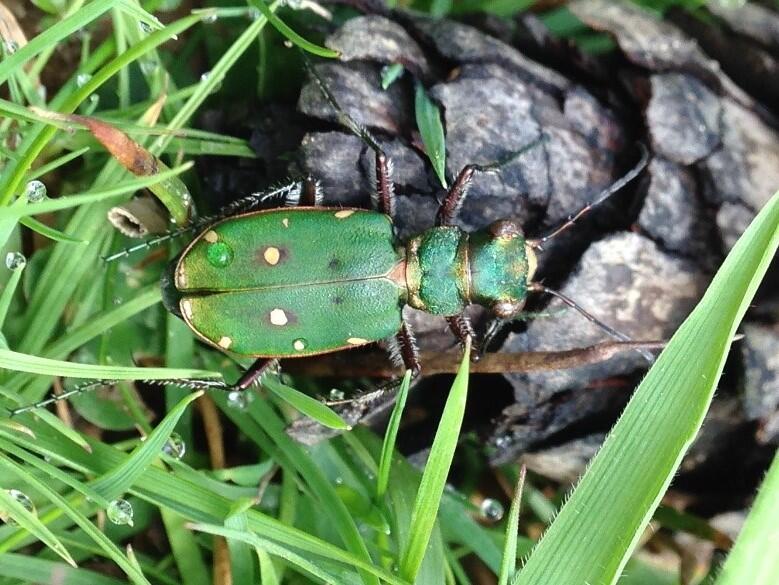

Green Tiger Beetles Successfully Bred in Captivity for the First Time
Posted: 18th May, 2021Green Tiger Beetles (Cicindela campestris) are large, striking beetles that are easily identified by their iridescent green colouring and characteristic yellow spots. They are relatively widespread in the UK and can be found in the spring and early summer. They are closely related to the Heath Tiger Beetle (Cicindela sylvatica), a species which is now extremely rare in the UK and found in only a handful of places in the south of England. Sadly, Heath Tiger Beetles have experienced a dramatic decline over the last few decades with the loss and degradation of lowland heathland.
To try to reverse this trend, the Species Recovery Trust and Sparsholt College have set up a captive breeding project for the Heath Tiger Beetle. The ultimate aim is to reintroduce beetles to suitable sites in England. However, the beetles are so rare and so little is known about their development that rather than risk taking any from the wild, the project is focussing on trying to breed Green Tiger Beetles first. The beetles are so closely related that the lessons learnt from breeding Green Tiger Beetles can be used in the future to breed Heath Tiger Beetles successfully.
In spring last year, Green Tiger Beetles were captured from the wild and moved to a dedicated enclosure at Sparsholt, designed to replicate their natural environment. Within a few weeks, a pair were observed mating and the female ovipositing her eggs in the sand. In a really exciting development, tiny larvae were then spotted, poking their heads out of their larval burrows.
Emma Lawlor, zookeeper at Sparsholt College said “I have been a part of this project from the start so I’m really excited to see the emergence of the larvae again after they buried down for autumn and winter to escape the adverse weather. For all of them to have survived their first year is fantastic news! The knowledge gained from rearing these beetles successfully can be used to help us to raise the rarer species of Tiger Beetles in the future, so our work here at Sparsholt College is invaluable for invertebrate conservation.”
Charlotte Carne, Programme Manager at the Species Recovery Trust, said: “We are incredibly excited by this project and the positive impact that it may have on the conservation of one of the rarest beetles in the country. We are really looking forward to seeing how the larvae develop over the coming months and to see the adults emerge next year. We are very grateful to the Valentine Charitable Trust for their support on this project.”
To find out more about the Species Recovery Trust, visit: www.speciesrecoverytrust.org.uk
Related Members
-
News
.png?w=100&h=100&zc=1&f=jpeg&hash=56a21b6f9a74c476c2111cf5d838ca8f) Zoo Founder Receives MBE for Conservation 19th June, 2026The former director of Newquay Zoo has been awarded an MBE for services to wildlife conservation. Stewart Muir MBE received the prestigious recognition…
Zoo Founder Receives MBE for Conservation 19th June, 2026The former director of Newquay Zoo has been awarded an MBE for services to wildlife conservation. Stewart Muir MBE received the prestigious recognition… -
News
.png?w=100&h=100&zc=1&f=jpeg&hash=be5a877ca3f704d28fd54d62b3b474a9) Celebrating Pride Month: Queer Pioneers in STEM 18th June, 2026Maddie Humfryes (Engagement Officer, Whipsnade Zoo) on some of the pioneers from the LGBTQ+ community who gave us immeasurable scientific and technological…
Celebrating Pride Month: Queer Pioneers in STEM 18th June, 2026Maddie Humfryes (Engagement Officer, Whipsnade Zoo) on some of the pioneers from the LGBTQ+ community who gave us immeasurable scientific and technological… -
News
.png?w=100&h=100&zc=1&f=jpeg&hash=48e20e6455badc3e6a4a17025ad88145) Surprise Arrival of Buffalo Calf 17th June, 2026Woburn Safari Park welcomes a Dwarf forest buffalo calf for the first time in over a decade. Woburn Safari Park is buzzing with excitement after a very…
Surprise Arrival of Buffalo Calf 17th June, 2026Woburn Safari Park welcomes a Dwarf forest buffalo calf for the first time in over a decade. Woburn Safari Park is buzzing with excitement after a very…