
Blog: Unveiling the elusive sea life of Weymouth
Posted: 19th August, 2026Even local shores are full of secrets, which is why Dr Samantha A. Hook (SEA LIFE) and her team have been uncovering the lives of skates and rays in the wild:
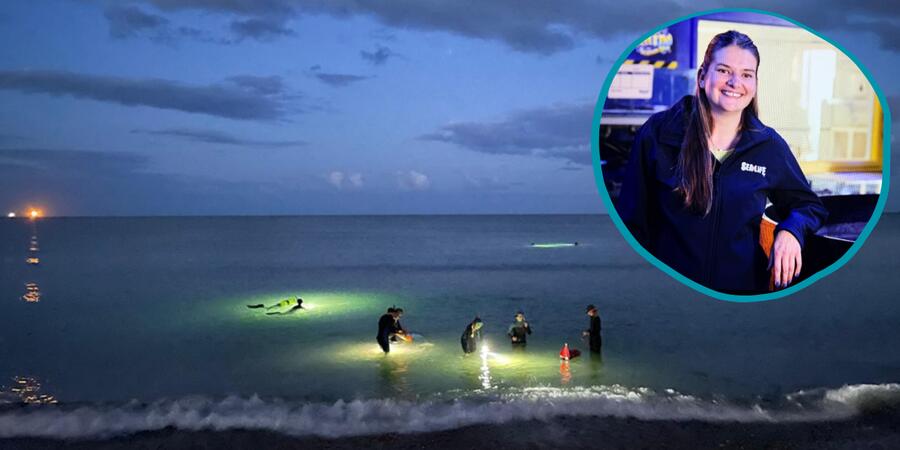
It is a warm, still evening on the Dorset coast. Along the shoreline of Weymouth Bay, aquarists from SEA LIFE gather with a sense of anticipation, waiting for the sunlight to disappear behind the chalk-white cliffs. As darkness settles, our work begins.
Since 2022, we have returned to this stretch of coastline each year with a simple goal: to uncover the hidden lives of some of the most elusive inhabitants of the bay's shallow sandy habitats, skates and rays. We are focused on one of the least understood stages of their lives; locating juvenile skates in the wild.
Our commitment to native elasmobranch conservation has been built on more than a decade of research and collaboration at SEA LIFE. Since 2009, we have coordinated the international studbook for the undulate skate (Raja undulata) and now manage the European Association of Zoos and Aquaria (EAZA) Ex-situ Programme for the species. In 2015, our team helped develop the first non-invasive genetic sampling technique for investigating parentage, providing valuable insights while maintaining the highest standards of animal welfare. More recently, our work has focused on understanding the behaviour and habitat preferences of juvenile skates, helping to identify and protect important nursery grounds.
To locate juvenile skates in the wild, we combined knowledge gained from aquarium observations with evidence collected in the field. Young skates favour sandy seabeds with high prey abundance and are often most active after dark. This led us to conduct underwater visual surveys (UVS) across Weymouth Bay at night.
When these surveys were first carried out during a conservation workshop in 2022, we didn’t expect much. However, at around 10 p.m., Scott, Curator at SEA LIFE Blackpool, spotted the first small skate gliding across the seabed. By the end of the UVS, five juvenile skates had been recorded. Even more surprising was their identity. Rather than the species we were out to find, they were small-eyed skates (Raja microocellata), an equally elusive species rarely observed at this life stage in the wild.
That discovery marked the beginning of an annual collaborative effort involving SEA LIFE teams from across the UK. Each year, these surveys have expanded our understanding of Weymouth Bay and the role it plays as a refuge for threatened skates. The growing body of evidence ultimately contributed to Weymouth Bay being recognised as an Important Shark and Ray Area (ISRA) by the IUCN SSC Shark Specialist Group in 2025, highlighting the bay's importance.
"Getting to take part in the underwater visual surveys is an incredible experience. By observing species in their natural environment, we can see the influence of weather, sea conditions and even human activities first-hand. It's also fascinating to witness interactions between species and the extraordinary diversity of life that exists even in shallow coastal waters."
- Sophie Armitage, Great Yarmouth SEA LIFE
These surveys have become increasingly important as our planet is in the sixth mass extinction, driven by human activity. Climate change is causing intense marine heatwaves, with multiple negative impacts on marine species. For skates and rays, it’s not clear how this will impact our populations. Rising temperatures can influence distribution, behaviour, prey availability and reproductive success, but detecting these changes requires long-term monitoring.
Non-invasive surveys such as the UVS in Weymouth Bay provide exactly this opportunity. By documenting which species are present, where they occur and how they use critical habitats over time, we can build the evidence needed to understand and respond to a rapidly changing ocean. These observations not only improve scientific knowledge but also help inform future conservation management.
What began as a search for baby skates has evolved into a long-term commitment to understanding and protecting the UK's nursery ecosystems. Every survey adds another piece to the puzzle, helping us uncover how these vulnerable species survive and adapt in an increasingly uncertain future.
To learn more about the Weymouth Bay Important Shark and Ray Area (ISRA), click here.
- Dr Samantha A. Hook, Global Science Manager, Conservation, Welfare and Education, SEA LIFE
(This project was one of the several nominated for the BIAZA Great British Wildlife Restoration Award 2026. We are now accepting entries for 2027! Find out how to enter here.)
All blogs reflect the views of their author and are not necessarily a reflection of BIAZA's positions
Related Members
-
News
.png?w=100&h=100&zc=1&f=jpeg&hash=aad86ef4c29c1be4f7d49d7ddd0ae3d7) Blog: photo competition ignites my childhood wonder for the natural world 4th September, 2026BIAZA’s Andrew Hall reflects on the success of BIAZA’s 2026 Photography Competition and how it speaks to a lifetime of love for nature… …
Blog: photo competition ignites my childhood wonder for the natural world 4th September, 2026BIAZA’s Andrew Hall reflects on the success of BIAZA’s 2026 Photography Competition and how it speaks to a lifetime of love for nature… … -
News
.png?w=100&h=100&zc=1&f=jpeg&hash=b758c447d510c7c32d3c5afb8454dab2) All Things Wild Launches Six-Year Conservation Strategy and ‘More Than Just Your Local Zoo’ Campaign 1st September, 2026All Things Wild has today launched its first-ever six-year Conservation Strategy alongside a new park-wide campaign, ‘More Than Just Your Local…
All Things Wild Launches Six-Year Conservation Strategy and ‘More Than Just Your Local Zoo’ Campaign 1st September, 2026All Things Wild has today launched its first-ever six-year Conservation Strategy alongside a new park-wide campaign, ‘More Than Just Your Local… -
News
.png?w=100&h=100&zc=1&f=jpeg&hash=4466a39223e36e593a9c2b10c32baa71) Family-run Northumberland Zoo begins its next chapter as a registered charity 1st September, 2026After more than a decade of growth, Northumberland Zoo is taking its biggest step yet by becoming a registered charity, creating new opportunities to…
Family-run Northumberland Zoo begins its next chapter as a registered charity 1st September, 2026After more than a decade of growth, Northumberland Zoo is taking its biggest step yet by becoming a registered charity, creating new opportunities to…