Rescue mission to save one of the world’s rarest plants wins prestigious Great British Wildlife Restoration prize
Posted: 27th January, 2025- Chester Zoo’s milestone Welsh restoration project won against 22 other native species projects for the coveted Great British Wildlife Restoration Award.
- The competition saw over 80 parliamentarians vote for native species projects, from beaver reintroductions to community waterway restoration, all led by British zoos and aquariums.
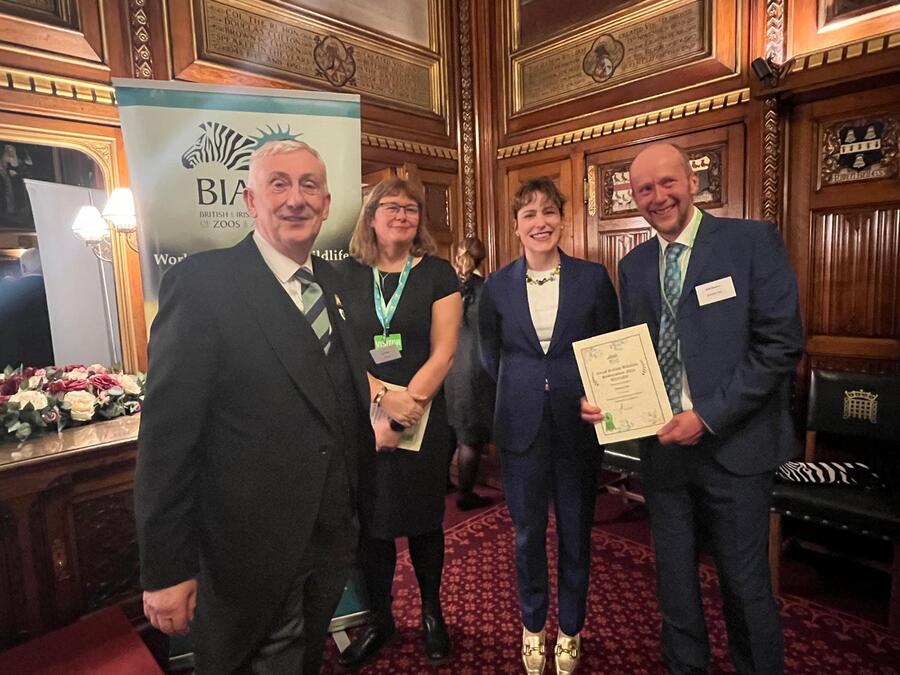
- The winner, voted by politicians, was announced at a special parliamentary reception hosted by the Speaker of the House of Commons Sir Lindsay Hoyle, featuring speeches by Defra Minister Sue Hayman and Shadow Secretary of State for the Environment Victoria Atkins
The daring rescue of one of Wales’ rarest shrubs was crowned the winner by Members of Parliament and the House of Lords in a special native species competition organised by BIAZA (the British and Irish Association of Zoos and Aquariums).
The project, Preventing the extinction of Wales’ Cotoneaster Cambricus by Chester Zoo involves the restoration of a Critically Endangered native shrub, found only in Wales. Its Welsh name Creigafal y Gogarth means the ‘Gogarth Rock Apple’ and its described as having beautiful red berries that resemble apples. Its wild population was down to just six individual plants in the 70s, having suffered from over-collecting and grazing.
Chester Zoo has been working with several partners to prevent this plant from being lost forever, and the zoo successfully grew 30 plants from seed. These were reintroduced to three different locations restoring the current wild population to nearly one-hundred plants!
At the event on 21 January, BIAZA brought together scores of people at Speakers House including MPs, Lords, and those representing zoos, aquariums and conservation organisations to celebrate the conservationists protecting our native wildlife.
Phil Esseen, Head of Plants at Chester Zoo said: “We are incredibly delighted to be recognised by our parliamentarians. Our work has restored a beautiful shrub to a beautiful country. It is so important our politicians champion our natural environment and it was great to be a part of the Great British Wildlife Restoration.”
Coming in second was Cryopreservation by Nature’s SAFE, an initiative which works with a variety of zoos to create a genetic bio-bank as a backup against extinction. Third place went to The Feisty Five by the Royal Zoological Society of Scotland. This project is recovering five highly threatened native invertebrates in the wild using purpose-built facilities in their two zoos.
The Great British Wildlife Restoration was organised by BIAZA to raise the profile of native species conservation in Westminster. The UK is one of the most nature depleted countries in the world and many iconic species including incredible butterflies, charismatic red squirrels and hedgehogs are at risk of being lost.
Andy Hall from BIAZA and the competition organiser said: “Nature needs the support of our politicians more than ever before. That is why last night was so important, we had politicians from across four parties come to talk about beaver restorations, leeches, choughs and rare trees. When people think of zoos they might think of lions or tigers, but the UK’s leading zoos are making a huge difference to plants, invertebrates and indeed entire landscapes right here in the UK.”
“It was so important that the Minister was there to see how much support there is for nature restoration out in society and that zoos and aquariums are taking a leading role in this.”
Related Members
-
News
.png?w=100&h=100&zc=1&f=jpeg&hash=a533c4e361fe17acb5eb0cc802bd596d) Blog: The smell of success - how Humans and Penguins coexist at Punta San Juan, Peru 24th August, 2026In this week's blog, Lloyd Wilkinson (Senior Aquarist & Penguin Keeper, The Deep) takes us to the shores of Peru to discuss how conservation comes…
Blog: The smell of success - how Humans and Penguins coexist at Punta San Juan, Peru 24th August, 2026In this week's blog, Lloyd Wilkinson (Senior Aquarist & Penguin Keeper, The Deep) takes us to the shores of Peru to discuss how conservation comes… -
News
.png?w=100&h=100&zc=1&f=jpeg&hash=f89705bdd5f27fea52fbf772e2029ece) Two Endangered horses from Marwell Zoo have been released to the wild 24th August, 2026Marwell Zoo has helped secure the future of one of the world’s rarest horse species with the successful release to the wild of two of its Endangered…
Two Endangered horses from Marwell Zoo have been released to the wild 24th August, 2026Marwell Zoo has helped secure the future of one of the world’s rarest horse species with the successful release to the wild of two of its Endangered… -
News
 Blog: Unveiling the elusive sea life of Weymouth 19th August, 2026Even local shores are full of secrets, which is why Dr Samantha A. Hook (SEA LIFE) and her team have been uncovering the lives of skates and rays in the…