.png?w=900&hash=3df70efa8f55dd0a0b592ade9130e0f0)
Sustainability in poetry - BIAZA Q&A with the author of The Rimba
Posted: 17th February, 2026This week, BIAZA interviewed author Jane Griffiths and illustrator Emma Lokuciejewski on their recent book ‘The Rimba’ – a poetical exploration of deforestation for a wide age range. After self-publishing in 2025, the book has since been raising funds for orangutans (and even Sir David Attenborough has a copy!)
Thank you for speaking to us. Firstly, what is the background behind The Rimba's production?
Jane: I first became aware of the destructive impact of palm oil in 2018, after watching Greenpeace’s Rang-tan campaign. I was horrified and determined to do something to reduce the damage by changing my own shopping choices.
I soon realised that avoiding palm oil altogether was not the best solution. Choosing sustainable palm oil was far more effective, and that understanding led me to do much more than simply change my shopping habits. After extensive research, I gave talks in local schools, met with managers at Newquay Zoo, and worked to help Newquay become a sustainable palm oil town — a cause I became deeply passionate about.
Sometime between 2018 and 2019, I heard a radio programme about deforestation that referenced The Lorax. I had never read the book, but bought a copy and was struck by how closely its message echoed what was happening in the rainforests of Southeast Asia. Its warning about greed and destruction felt painfully relevant.
That moment stayed with me, and it became the starting point for The Rimba.
What does the figurehead of your story, the Rimba, represent?
Jane: The name is deliberately ambiguous. Rimba is Indonesian for jungle, forest and wilderness. It has connotations of natural beauty and rich biodiversity. So the book is really about that, BUT, it is also the name of the central mystical and spiritual orangutan ‘mother’ who is a rainforest guardian. The Rimba represents the living rainforest itself, — not just as a place, but as something sentient and vulnerable. Through her, the rainforest is no longer a distant concept, it becomes an embodiment of all the animals and their habitats and helps the readers, especially children to form an emotional connection with what is being lost.
Why did you choose to present environmental themes with a spiritual lens?
Jane: Using a spiritual perspective allows readers, especially children, to feel the forest’s importance emotionally and morally. It turns the rainforest into more than a backdrop—it becomes a presence, almost a character, whose wellbeing reflects our own choices. This makes the threats of deforestation, habitat loss, and species decline more immediate and meaningful, without resorting to didactic or fear-based messaging.
Like the Lorax, the Rimba is a voice of reason; intelligent articulate and compassionate. It seemed more poignant to make her ‘spiritual’, because although she is an elderly orangutan figure, she is representative of both the rainforest and its animals; all those who who cannot speak for themselves.
A spiritual lens has much more kudos and importance - rather like the spirits in Dicken’s ‘A Christmas Carol” - the Rimba is all seeing, all knowing. We listen to her believe in her and empathise.
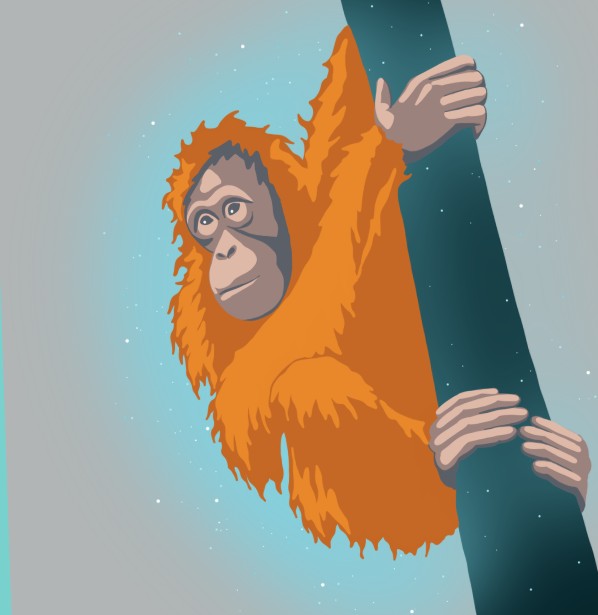
Emma, as an orangutanologist, how does your experience protecting orangutans support your work as an illustrator?
Emma: My passions lie within art and science, but it is rare that these two are combined. Scientific research tends to be very structured and formal, whereas illustration allows me to have freedom to create without boundaries. Using illustration as a tool to convey scientific information is therefore a unique but important tool that allows it to be more accessible to a wider audience, especially kids! Through my own experience within the field of orangutan conservation, I can show the readers what the impacts of palm oil look like, and how this affects the orangutans.
What inspired your love for orangutans?
Jane: Perhaps orangutans appeal to us more than any other rainforest creature because we are genetically closest to them. I realise that’s a generalisation, but for me, my love for orangutans comes from their gentle nature and the profound losses they’ve suffered—they are critically endangered. There’s something in their eyes that feels knowing, almost as if they hold us when we look at them.
They spend nearly their entire lives in the trees; the rainforest is their home. Because my story is about rainforest destruction, it felt fitting to feature a wise orangutan as the protagonist—a creature so intimately connected to the forest that their story reflects the forest’s story, too. Through them, I hoped to show both the fragility and the beauty of this incredible ecosystem, and the urgent need to protect it.
Emma: I grew up with a passion for nature, and Orangutans were the species that stood out to me as a child. I quickly became obsessed with them and their intelligence and unique behaviours. Once I realised I could study orangutans for a career, I tailored my education towards those goals. The more I learn about them, the cooler, and weirder and more interesting they become!
What can we all do to prevent rainforest destruction, and how can we all lend our voices to motivating sustainable practices?
Emma: We all use products or ingredients that come from rainforests, so we all have a responsibility to ensure they are from sustainable sources. There are many things we can do to help this process, but most importantly, doing something is better than staying silent, no matter how small. We can all share the story of the plight of the orangutan, through talking to friends or sharing information on social media. We can raise or donate money to conservation organisations. We can look at what products we buy and make sustainable swaps. Those are simple yet effective ways to help out.
Towards the end of the book you have written ‘choose sustainable palm oil, where you can. It makes no sense to support a ban.’ How can we prevent misconceptions between choosing sustainable palm oil, and banning it outright?
Jane: There is no doubt that palm oil feels like a moral minefield for consumers. Many people believe the only ethical choice is to boycott it altogether, which is why we need to keep repeating a crucial point: the real choice is unsustainable palm oil versus sustainable palm oil — not palm oil versus nothing.
Banning palm oil doesn’t remove the demand for vegetable oil; it simply shifts it to alternatives such as soy, rapeseed or sunflower, which often require more land and can lead to even greater deforestation. Choosing sustainable palm oil is neither passive nor weak — it is a powerful use of consumer choice to reward better practices and encourage change from within the system, rather than walking away from it.
Change begins with education and understanding, and I hope The Rimba plays a small part in that. It recognises the reality of the challenges we face while still offering hope. The story ends, but a door opens — to awareness, responsibility and hope.
Find out more about The Rimba here, and there is also a free education pack here about sustainable palm oil.
All blogs reflect the views of their author and are not necessarily a reflection of BIAZA's position
-
News
.png?w=100&h=100&zc=1&f=jpeg&hash=a533c4e361fe17acb5eb0cc802bd596d) Blog: The smell of success - how Humans and Penguins coexist at Punta San Juan, Peru 24th August, 2026In this week's blog, Lloyd Wilkinson (Senior Aquarist & Penguin Keeper, The Deep) takes us to the shores of Peru to discuss how conservation comes…
Blog: The smell of success - how Humans and Penguins coexist at Punta San Juan, Peru 24th August, 2026In this week's blog, Lloyd Wilkinson (Senior Aquarist & Penguin Keeper, The Deep) takes us to the shores of Peru to discuss how conservation comes… -
News
.png?w=100&h=100&zc=1&f=jpeg&hash=f89705bdd5f27fea52fbf772e2029ece) Two Endangered horses from Marwell Zoo have been released to the wild 24th August, 2026Marwell Zoo has helped secure the future of one of the world’s rarest horse species with the successful release to the wild of two of its Endangered…
Two Endangered horses from Marwell Zoo have been released to the wild 24th August, 2026Marwell Zoo has helped secure the future of one of the world’s rarest horse species with the successful release to the wild of two of its Endangered… -
News
 Blog: Unveiling the elusive sea life of Weymouth 19th August, 2026Even local shores are full of secrets, which is why Dr Samantha A. Hook (SEA LIFE) and her team have been uncovering the lives of skates and rays in the…