
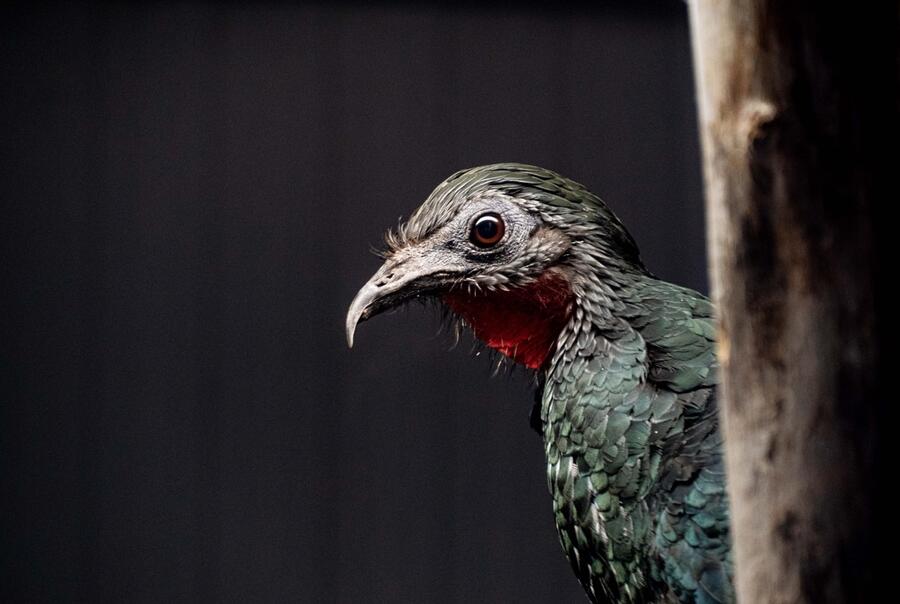

The mystery bird that howls at the moon… meet the Spix’s Guan
Posted: 5th November, 2024As the nights draw in and there’s a chill in the air, learn about a strange howling bird that lives in Bristol…
Noah’s Ark Zoo Farm is home to the UK's only Spix's Guan, a rare bird with a quirky night-time habit that’s been delighting staff. This curious creature adds a special charm to the zoo’s evenings with its signature serenade under the moonlit sky.
The Spix’s guan, native to the forests of South America, resides in the Macaw Aviary at the zoo, where its unique call echoes through the Somerset nights. As the moon rises, this feathered friend lets out a distinctive vocalisation—a captivating and slightly strange mix between a bark and a yell. It’s a sound that has become a much talked about point in the zoo’s staff room.
Noah’s Ark Zoo Farm is proud to be the only zoo in the UK to house the charismatic Spix’s Guan. Known for their vibrant plumage and lively personalities, Spix's guans are typically heard calling out to one another at dawn and dusk. But they also seem to have a special affinity for the moon, making it a unique species that draws attention from near and far.
Larry Bush, CEO at Noah’s Ark Zoo Farm commented, “Although the Spix’s Guan are not nocturnal, they are often heard making frightening, yelling noises on moonlit nights. We’ve grown very fond of this charming, but bizarre behaviour, although I’ve never heard it myself so it’s still very mysterious. Our Spix Guan has become a staff favourite and has even made it into our October half term visitor trail!”
While the Spix’s guan has captured hearts with its moonlit melodies, it’s also playing a crucial role in raising awareness about its species. By offering a home to this charming bird, Noah’s Ark Zoo Farm is contributing to the global effort to safeguard this species for future generations.
Related Members
-
News
.png?w=100&h=100&zc=1&f=jpeg&hash=aad86ef4c29c1be4f7d49d7ddd0ae3d7) Blog: photo competition ignites my childhood wonder for the natural world 4th September, 2026BIAZA’s Andrew Hall reflects on the success of BIAZA’s 2026 Photography Competition and how it speaks to a lifetime of love for nature… …
Blog: photo competition ignites my childhood wonder for the natural world 4th September, 2026BIAZA’s Andrew Hall reflects on the success of BIAZA’s 2026 Photography Competition and how it speaks to a lifetime of love for nature… … -
News
.png?w=100&h=100&zc=1&f=jpeg&hash=b758c447d510c7c32d3c5afb8454dab2) All Things Wild Launches Six-Year Conservation Strategy and ‘More Than Just Your Local Zoo’ Campaign 1st September, 2026All Things Wild has today launched its first-ever six-year Conservation Strategy alongside a new park-wide campaign, ‘More Than Just Your Local…
All Things Wild Launches Six-Year Conservation Strategy and ‘More Than Just Your Local Zoo’ Campaign 1st September, 2026All Things Wild has today launched its first-ever six-year Conservation Strategy alongside a new park-wide campaign, ‘More Than Just Your Local… -
News
.png?w=100&h=100&zc=1&f=jpeg&hash=4466a39223e36e593a9c2b10c32baa71) Family-run Northumberland Zoo begins its next chapter as a registered charity 1st September, 2026After more than a decade of growth, Northumberland Zoo is taking its biggest step yet by becoming a registered charity, creating new opportunities to…
Family-run Northumberland Zoo begins its next chapter as a registered charity 1st September, 2026After more than a decade of growth, Northumberland Zoo is taking its biggest step yet by becoming a registered charity, creating new opportunities to…