
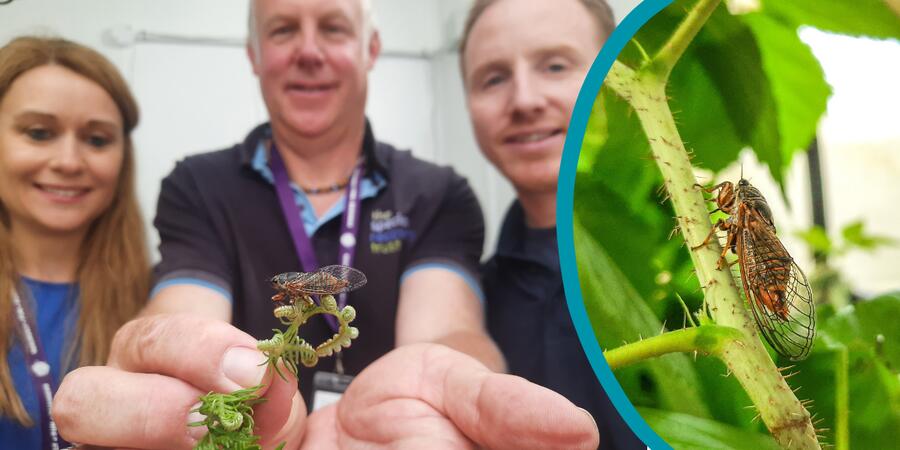

Singing cicadas brought back to Britain from France for reintroduction
Posted: 27th June, 2025Musical insects that went extinct in the UK have been brought back to Britain from France for the first time.
Scientists at the Species Recovery Trust are hoping to reintroduce the New Forest Cicada to the woods where it once sang.
They have brought 11 of the insects to a specially-created habitat at Paultons Park in Romsey, just outside the New Forest, where they will rear them before releasing them into the wild.
Species Recovery Trust project officer Charlotte Carne said: "This has been a really challenging project so it's amazing to see New Forest Cicadas in England after all this time. It's like bringing them back from the dead."
The New Forest Cicada, Cicadetta montana, was once found across the New Forest but the last confirmed sightings were in the 1990s.
Adults are black with distinct golden rings and transparent wings. Females grow to about 5cm and males are slightly smaller.
This week the Trust recruited a French entomologist who captured 11 female cicadas of the same species in northern France, and had them shipped to the UK on Wednesday June 11.
On the morning of Thursday June 12, Charlotte and the zoo team at Paultons Park released the cicadas into specially-created habitats containing their favourite plants, raspberry canes and hazel tree saplings.
Now they have to hope they lay eggs in the plants - but even if that happens the cicadas will spend at least four years underground as nymphs, so the Trust won't know until 2029 at the earliest whether this phase of the project has been successful.
If it is, they can then release the adults at secret locations in the New Forest. The team are also hoping to import more cicadas from France to continue the breeding programme at Paultons Park.
They are even studying populations of the same species in Slovenia to learn more about their behaviour.
Species Recovery Trust director Dominic Price said: "We believe the New Forest Cicada probably went extinct because of changes to the way land was managed, but we have worked with Forestry England to put the right kind of management in place. What's more, we think that our warming climate could also favour their survival, so we are very hopeful that one day soon, cicadas will sing in the New Forest again.”
The first-of-its-kind project has been funded by Natural England, the Swire Charitable Trust and the Valentine Charitable Trust.
Graham Horton, Acting Deputy Director for the Thames Solent Area Team at Natural England, said: “This project represents a remarkable achievement, showcasing the dedication, innovation, and teamwork that made it possible. After years of absence, we finally have New Forest Cicada on English shores again and we look forward to the next phase of the project to explore re-establishing this species in the New Forest.”
Find out more at speciesrecoverytrust.org.uk and follow the trust at facebook.com/TheSpeciesRecoveryTrust
Related Members
-
News
.png?w=100&h=100&zc=1&f=jpeg&hash=aad86ef4c29c1be4f7d49d7ddd0ae3d7) Blog: photo competition ignites my childhood wonder for the natural world 4th September, 2026BIAZA’s Andrew Hall reflects on the success of BIAZA’s 2026 Photography Competition and how it speaks to a lifetime of love for nature… …
Blog: photo competition ignites my childhood wonder for the natural world 4th September, 2026BIAZA’s Andrew Hall reflects on the success of BIAZA’s 2026 Photography Competition and how it speaks to a lifetime of love for nature… … -
News
.png?w=100&h=100&zc=1&f=jpeg&hash=b758c447d510c7c32d3c5afb8454dab2) All Things Wild Launches Six-Year Conservation Strategy and ‘More Than Just Your Local Zoo’ Campaign 1st September, 2026All Things Wild has today launched its first-ever six-year Conservation Strategy alongside a new park-wide campaign, ‘More Than Just Your Local…
All Things Wild Launches Six-Year Conservation Strategy and ‘More Than Just Your Local Zoo’ Campaign 1st September, 2026All Things Wild has today launched its first-ever six-year Conservation Strategy alongside a new park-wide campaign, ‘More Than Just Your Local… -
News
.png?w=100&h=100&zc=1&f=jpeg&hash=4466a39223e36e593a9c2b10c32baa71) Family-run Northumberland Zoo begins its next chapter as a registered charity 1st September, 2026After more than a decade of growth, Northumberland Zoo is taking its biggest step yet by becoming a registered charity, creating new opportunities to…
Family-run Northumberland Zoo begins its next chapter as a registered charity 1st September, 2026After more than a decade of growth, Northumberland Zoo is taking its biggest step yet by becoming a registered charity, creating new opportunities to…